The July 2026 action distinguishes previously authorized equipment from new covered equipment. Your exact model, configuration and current authorization still matter.
Possibly—but the July FCC notice is not a purchase clearance for every Unitree robot. The FCC’s July 2026 fact sheet says that its action does not prohibit the import, sale or marketing of previously authorized models, or continued use of devices already bought. New covered equipment faces an authorization barrier, with a conditional-approval exception. Before ordering, verify the exact model and configuration, its authorization record and any later restrictions.[1][2]
Editorial review: 25 October 2026. This draft draws on the July FCC documents linked below. We have not independently confirmed the current authorization of any specific Unitree model or the complete current Covered List. A review date does not mean every model is cleared for sale today.
A robot being available in a seller’s store and a robot being authorized for a particular US transaction are different questions. For buyers considering a Unitree Go2, G1 or another quadruped or humanoid, the useful question is: what evidence supports this exact unit?
What did the FCC actually do?
On 28 July 2026, the FCC’s Public Safety and Homeland Security Bureau released DA 26-786. It added a category of foreign-produced advanced robotic devices to the Covered List, with an exception for devices granted Conditional Approval by the Department of War (DoW), as named in the notice.[2]
This is a category-based entry. It is not limited to a company named Unitree, and the July entry is not limited to China. Whether a particular device falls within the category requires applying the official definition and exclusions. We are not reproducing numerical thresholds from secondary summaries because the definition appendix has not been fully verified in this review.
Can I still buy a Unitree robot in the US?
The FCC fact sheet provides a distinction—not a verified list of purchasable Unitree models:[1]
- Previously authorized models: the July action does not prohibit their import, sale or marketing. That statement describes the effect of this action; it does not establish that every current listing, hardware revision or shipment is compliant.
- New covered equipment: it cannot receive a new FCC equipment authorization while covered. The notice provides a conditional-approval exception, but an exception is not itself an equipment authorization.[2]
- Robots already owned: the July action does not require consumers to stop using devices they already purchased. Other applicable operating requirements still matter.
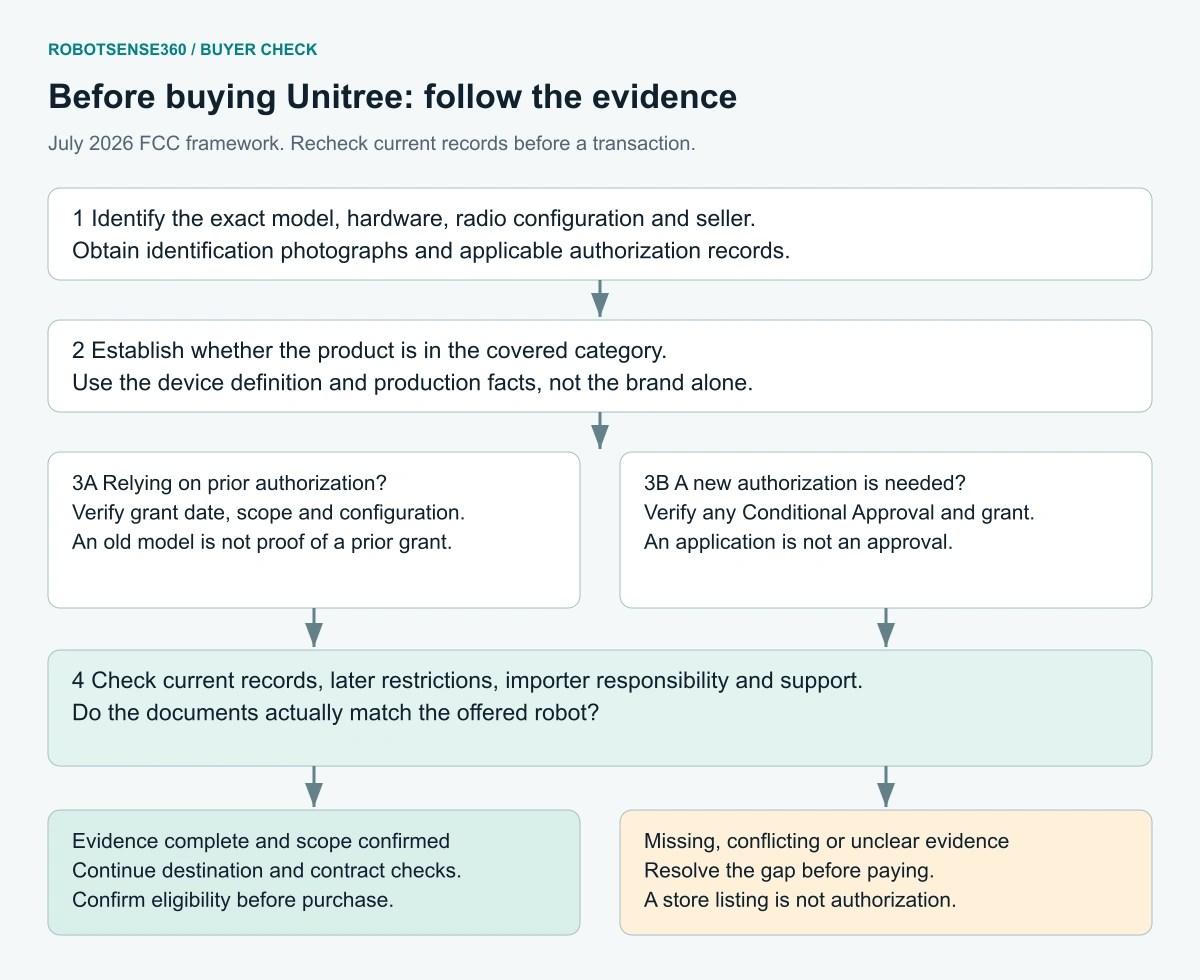
A grant date alone is insufficient. A seller should be able to connect the grant, approved equipment and delivered configuration. A radio-module identifier should not be assumed to establish authorization for the complete robot without checking the applicable integration conditions.
Which Unitree models are verified?
None is certified by this article as currently buyable. We removed the original draft’s Go1, Go2, B2, G1, R1, A2 and H2 FCC-ID table because its model mappings and dates relied on snippets and secondary sources rather than an independently checked set of FCC records.
That does not establish that those robots lack authorization. It means this article cannot responsibly use that table to recommend a purchase.
| Evidence to request | What to match | Why it matters |
|---|---|---|
| Exact SKU and hardware revision | Quotation, label and delivered unit | A family name can cover different configurations |
| Applicable FCC ID and grant | Official record, equipment description and conditions | A label or application date alone is not enough |
| Current authorization status | Later orders, changes and exceptions | The July notice is not the complete current record |
| Importer and seller documentation | Destination, warranty and returns | Availability and support are separate from authorization |
| Firmware and support statement | Installed version and relevant fixes | Regulatory status does not establish cybersecurity |
How should a buyer check the evidence?
Photo placeholder: a clear image of the actual unit’s regulatory label, supplied by the seller or photographed by the editor. No hands-on inspection has been performed for this article.
- Obtain the exact SKU, hardware revision and a readable label photograph before paying.
- Look up the applicable identifier in the FCC equipment authorization search. Use mirrors as leads, then check the official grant and exhibits.
- Match the equipment description, grant conditions and any relevant integration requirements to the offered unit. Distinguish an application date from a grant date.
- Review the current Covered List and any later model-specific orders or exceptions. Request the document number for any claimed Conditional Approval.
- Ask the seller or importer to document the basis for supplying that configuration to your destination, together with warranty, returns and firmware support.
- Resolve missing or contradictory evidence before payment. For organizational procurement, have the responsible compliance team review the transaction and any separate procurement restrictions.
This is an editorial purchasing checklist, not a legal opinion. We could not complete a live, model-by-model FCC database check during this review.
Can existing robots still receive updates?
DA 26-789 provides relief for certain Class I and Class II permissive software or firmware changes that mitigate harm for devices authorized before 28 July 2026. The document includes security, functionality and operating-system compatibility updates, and states that the relief lasts at least until 1 January 2029.[3]
That is not a promise that a manufacturer will maintain your robot until that date. It is also not a blanket permission for new equipment, every hardware modification or every change to an authorized device. Check the scope and conditions of the relevant order, including any later device-specific relief.
What about Unitree security vulnerabilities?
Authorization and cybersecurity answer different questions. Two historical disclosures deserve attention when evaluating a used or new robot:
- CVE-2025-2894: the GitHub advisory describes an undocumented remote-access issue involving CloudSail on the Go1. Its listing gives affected and patched versions as unknown. It cannot establish that a unit on sale today is patched.[4]
- UniPwn: researchers disclosed a Bluetooth LE attack chain in September 2025 and identified Go2, G1, H1 and B2 in their report. This is a historical researcher claim about affected equipment, not an independent test of every current firmware build.[5]
Ask for version-specific evidence. Obtain the installed firmware version, the manufacturer’s relevant advisory or release notes, and confirmation of how updates will be delivered. Network isolation can limit some exposure, but Wi-Fi isolation does not by itself remove a nearby Bluetooth attack path. Restrict unnecessary connectivity where supported, control physical access and use documented update procedures. This review does not establish a currently safe firmware version.
What does the GUARD Act change?
The introduced text of H.R. 9129, the GUARD Act, is dated 3 June 2026. The Congressional Record for 1 September records that the House Communications and Technology Subcommittee forwarded it to the full committee without amendment.[6][7]
Those records establish historical legislative steps. They do not establish the bill’s complete status on the day you buy a robot. We removed the original draft’s unsupported claim about a voice vote and its blanket statement that the bill has no effect today. Check the current legislative record before drawing a present-day conclusion.
The introduced Senate text of S. 4235, the American Security Robotics Act of 2026, concerns executive-agency procurement and operation of certain unmanned ground vehicles.[8] Federal procurement proposals and consumer equipment authorization should be examined separately; one does not settle the other.
Which dates should buyers track?
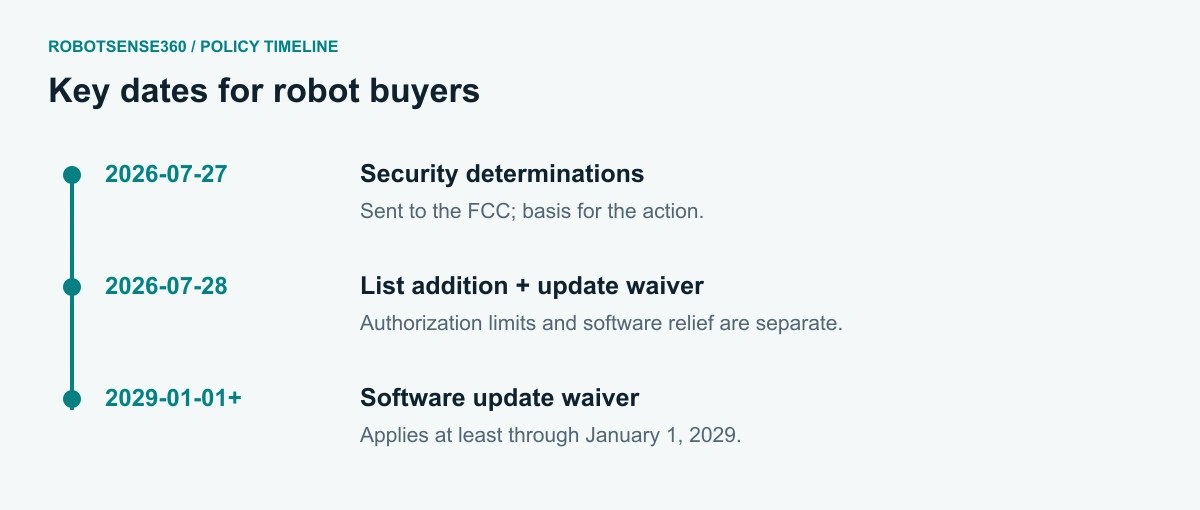
The July notices explain the initial category entry and update relief. The January 2029 date belongs to the update waiver; it is not a universal purchase deadline or a guaranteed support period. We have omitted unverified application deadlines, domestic-content percentages and reported approvals for other companies.
Frequently asked questions
Does the FCC notice mean all Unitree robots are banned?
No blanket answer follows from the July documents. The category entry, prior authorization and any applicable exceptions matter. This article has not verified a specific Unitree configuration for current purchase.
Can I keep using a robot I already own?
The FCC’s July fact sheet says this action does not stop consumers using devices already bought. That statement is about the July action, not every separate requirement that may apply.
Is a seller’s FCC ID enough?
No. Match the official grant, conditions and equipment to the exact configuration, then check current status and later orders. An identifier alone does not establish that a particular shipment is compliant.
Does the update waiver mean my robot is secure?
No. Permission for certain updates does not prove that an update exists, has been installed or fixes a particular vulnerability. Request version-specific evidence.
Buy on verified documents, not a blanket yes. The July FCC action preserves a path for previously authorized models, but this review does not clear any particular Unitree robot for purchase today. Get the exact configuration, applicable authorization and current regulatory record before paying, and evaluate support and security separately.
Editorial disclosure: This article contains no affiliate links. RobotSense360 has not physically tested the robots discussed here. Diagrams are editorial illustrations; the photograph position is a placeholder.
Sources
- FCC, Fact Sheet DOC-423682A1, July 2026, especially pages 1 and 3. docs.fcc.gov/public/attachments/DOC-423682A1.pdf
- FCC, DA 26-786, Public Notice, 28 July 2026, especially pages 3–4. docs.fcc.gov/public/attachments/DA-26-786A1.pdf
- FCC OET, DA 26-789, 28 July 2026, pages 1–3. docs.fcc.gov/public/attachments/DA-26-789A1.pdf
- GitHub Advisory GHSA-23cv-w96c-877f, CVE-2025-2894, published 28 March 2025; unreviewed advisory, patched versions unknown. github.com/advisories/GHSA-23cv-w96c-877f
- Bin4ry and collaborators, UniPwn research repository, disclosure dated 20 September 2025. github.com/Bin4ry/UniPwn
- H.R. 9129, introduced House bill, 3 June 2026. www.govinfo.gov/content/pkg/BILLS-119hr9129ih/pdf/BILLS-119hr9129ih.pd
- Congressional Record Daily Digest, 1 September 2026, page D856. www.govinfo.gov/content/pkg/CREC-2026-09-01/pdf/CREC-2026-09-01-pt1-Pg
- S. 4235, introduced Senate bill, 26 March 2026. www.govinfo.gov/app/details/BILLS-119s4235is
Leave a Reply